

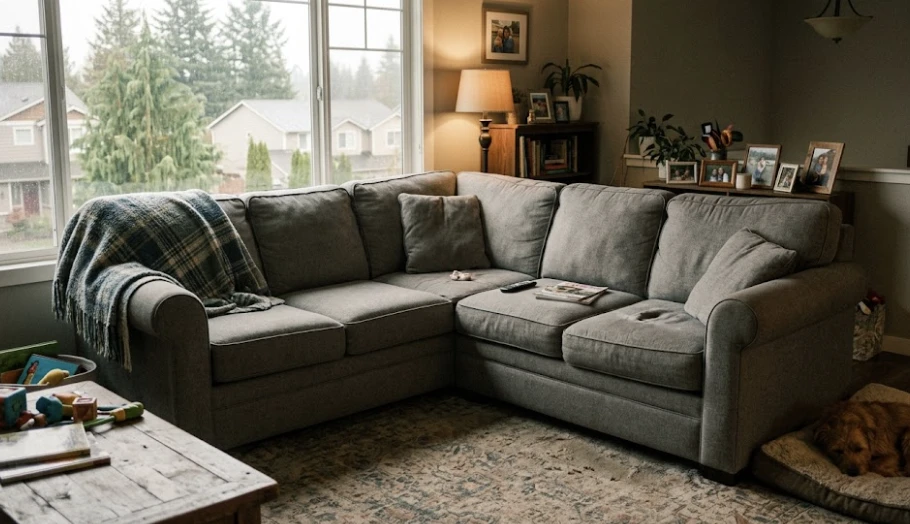
Think about what your couch survived last year. The Super Bowl with eight people, three of whom spilled something. The toddler who treats the left cushion as a personal trampoline. The dog who jumps up the moment you leave the room. The coffee that was fine until it wasn’t — and then the quick wipe that felt like it handled things but probably didn’t reach the foam underneath. Family couches work hard. The evidence tends to accumulate quietly, invisible until it isn’t.
This is the reality of upholstered furniture in an active household. And it explains why professional couch cleaning is a fundamentally different service from wiping down the cushions with a damp cloth — not because professionals have magic chemicals, but because the problems a heavily used couch develops over time are structural, not just surface-level.
What’s Actually Inside the Cushions After 18 Months
The human body sheds roughly 30,000 to 40,000 dead skin cells every hour. A meaningful portion ends up in upholstered furniture, particularly in the gaps between cushions and deep in the pile of the fabric. This is normal and unavoidable. It’s also a food source for dust mites, which are present in virtually every home in western Washington at levels that fluctuate with season and humidity.
Dust mites themselves don’t bite. Their waste products are the issue. Dust mite feces are a well-documented allergen — they’re one of the primary indoor triggers for asthma and allergic rhinitis, and they concentrate in soft furnishings exactly because those are the places where their food supply is richest. A couch in regular use that hasn’t been properly deep cleaned in two years can harbor mite populations significant enough to affect indoor air quality, particularly during fall and winter when western Washington homes are sealed up and air circulation drops.
Pets add a separate layer. Dog and cat dander is a different allergen from dust mite waste — it’s composed of tiny protein particles shed from skin and saliva, and it clings to fabric with unusual persistence. A damp cloth run over a cushion after the dog’s been on it doesn’t touch dander levels in the fabric. Dander particles bond to upholstery fibers and require enzymatic treatment to break down. People who say “I vacuum it every week” and wonder why they still react to the couch are usually dealing with dander that’s been embedded in the weave for months.
Then there’s body oil — the accumulated transfer from skin contact that soaks into the arm rests, the seat cushions, the headrest area of a sectional. You don’t see it building up because it happens gradually, but over 18 months to two years it creates a residue that traps additional soil, dulls the fabric color, and contributes to the gradual “grayish” cast that couches develop with age. This is one of the reasons a professionally cleaned couch often looks noticeably brighter — it’s not a different color, the surface was just covered.
Why the Tag on Your Couch Actually Matters
Not all couches clean the same way, and this is where a lot of self-treatment attempts cause damage that wasn’t there before. Check the underside of a cushion or the back of your couch for a tag with a cleaning code. It’s usually a small white label with a letter or letters: W, S, S/W, or X.
W means water-based cleaning solutions are safe to use. S means solvent only — water will cause shrinkage, permanent watermarks, or fabric distortion. S/W means either approach works. X means vacuum only: no liquid of any kind should touch the fabric. A notable percentage of sofas sold in the US carry an S code, which most homeowners discover only after they’ve already used a wet cloth and are now looking at a watermark ring that won’t come out.
The fabrics that confuse people most are the trendy ones. Velvet — which has been in almost every furniture catalog for the past four or five years — has a pile structure that can be permanently crushed if pressure is applied while the fabric is wet. Once velvet pile is compacted in the wrong direction and dries that way, it doesn’t recover without professional intervention. Boucle and certain chenilles behave similarly. These are not obscure edge cases; they’re among the most common sofa fabrics sold in the Seattle metro area right now, and almost none of the standard cleaning guides written for older fabric types account for them.
Microfiber is technically easier to clean than natural fiber, but it has its own quirk: it watermarks easily if too much moisture is applied, and the texture changes permanently if scrubbed rather than blotted. The instinct to scrub at a stain on microfiber almost always makes the problem larger and more visible, not smaller. The right technique is blot outward from the center of the stain with cold water, then apply minimal heat to dry quickly. Most people do the opposite of most of these things.
What Professional Equipment Actually Does Differently
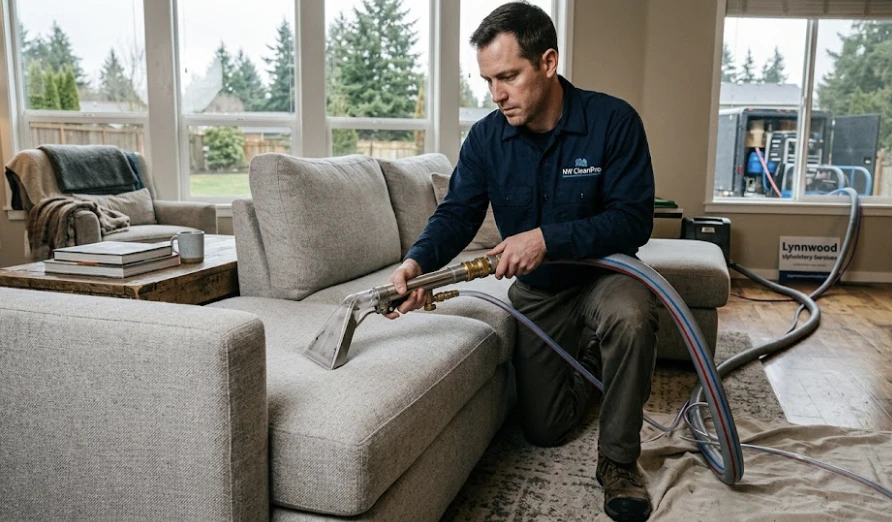
Hot water extraction — when appropriate for the fabric type — works by injecting cleaning solution at controlled temperature and pressure into the upholstery, then extracting it along with the suspended soils and contaminants. The extraction force of professional-grade equipment is categorically different from a home carpet shampooer or the portable steam cleaners sold at hardware stores. This difference matters for one specific reason: residual moisture and residual cleaning solution left in upholstery fabric are both problems. Cleaning residue attracts new soil faster than untreated fabric. And residual moisture in a Lynnwood home from October through April — when windows stay closed and interior humidity stays elevated — is a direct path to mildew developing inside the cushion foam.
Pre-treatment is the step that makes professional cleaning effective in ways home treatment can’t replicate. Different stains require chemically different approaches. Protein stains — pet urine, blood, food — need enzymatic solutions that break down protein structure. Grease and oil need a different solvent entirely. Tannin stains from coffee or wine respond to yet another approach. Running hot water over an untreated protein stain, for example, can set it permanently: heat denatures proteins and bonds them to fiber. This is why the “steam it out” instinct for a pet accident is one of the worst things you can do.
Drying management is underrated. After professional cleaning, proper drying — with consistent airflow, typically fans running — prevents the damp, mildewy smell that follows amateur upholstery cleaning in damp climates. A couch that’s been over-wetted and left to dry in still air in a closed western Washington home in November will smell like wet wool within 48 hours. The smell isn’t leftover dirt resurfacing; it’s mildew beginning to grow in foam that didn’t dry fast enough. Professional services know this. The ones that don’t warn you about post-cleaning ventilation tend to be the ones you call back to deal with the smell.
The Lynnwood Climate and What It Does to Indoor Fabric Year-Round
Lynnwood sits at about 450 feet elevation in Snohomish County and gets roughly 40 inches of rain annually — similar to the Bothell and Kenmore area to the south. From October through April, relative humidity indoors stays higher than in drier climates even with heating, because the moisture comes from outside air that’s perpetually damp. This creates specific conditions for upholstered furniture that don’t apply in Phoenix or Denver.
High ambient humidity slows drying after any moisture exposure — spills, pet accidents, spot cleaning. A cushion that appears dry to the touch after 24 hours may still hold moisture in the dense foam core. In that state, the cushion smells fine for another week or two, and then doesn’t. Families who notice their couch smelling “musty” in fall or winter without any obvious incident often aren’t imagining things — they’re dealing with accumulated humidity absorption over multiple seasons combined with whatever moisture has gotten into the cushions from spills that seemed fine at the time.
Lynnwood also gets less direct sunlight than most people realize — overcast days dominate from November through February — which means UV exposure that might otherwise help suppress surface microbes simply isn’t present for much of the year. Indoors, that translates to slightly more favorable conditions for mold and mite growth in soft furnishings than you’d find in sunnier climates.
Fresh Stains vs. Two Years of Accumulation — What Home Cleaning Handles
Fresh stains caught within minutes are genuinely manageable at home if you know what you’re doing. Blot, never rub — rubbing drives the stain deeper into the fiber pile and spreads it laterally. Use cold water for protein stains. Check the fabric code before applying any liquid. Then dry quickly — a small fan aimed at the treated spot for an hour prevents watermarks and mildew. This works. The problem is that most spills don’t get this treatment; they get a hurried wipe with whatever’s nearby, which does something to the surface and very little to the fiber.
What home treatment doesn’t address is what’s already worked into the foam and batting beneath the fabric: years of accumulated body oil, the dust mite colonies in the cushion fill, the odor compounds absorbed into the foam itself. Couches don’t just smell from surface contamination. The foam core absorbs and retains odor molecules over time, and surface cleaning doesn’t reach it. Baking soda on the cushions, which is the most popular DIY remedy, addresses surface odors for a few days. It does not treat the source.
Families in Lynnwood with kids or pets realistically need professional cleaning every 12 to 18 months. Households of adults without pets can reasonably go every two years. After a significant event — a stomach bug through the family, a pet accident that soaked through to the foam, a wine spill that was “handled” at the time — professional treatment makes sense regardless of when the couch was last cleaned.
Anyone looking for professional couch cleaning in Lynnwood WA should ask three questions before booking: what cleaning method they use for your specific fabric type, how drying is managed after the service, and whether pet odor treatment is included or priced separately. The answers tell you quickly whether you’re talking to someone who knows upholstery or someone who cleans carpet and also does sofas on the side.
What It Actually Costs to Neglect This — and What Regular Cleaning Preserves
A quality sofa — solid hardwood frame, high-density foam rated at 1.8 lbs per cubic foot or above, durable upholstery — should realistically last 15 to 20 years. Most furniture retailers quote seven to ten years, which reflects how long average couches last under average care, not how long they could last. The mechanisms of early failure are predictable: foam compression, fabric degradation, and frame loosening. Regular professional cleaning directly addresses the second of these.
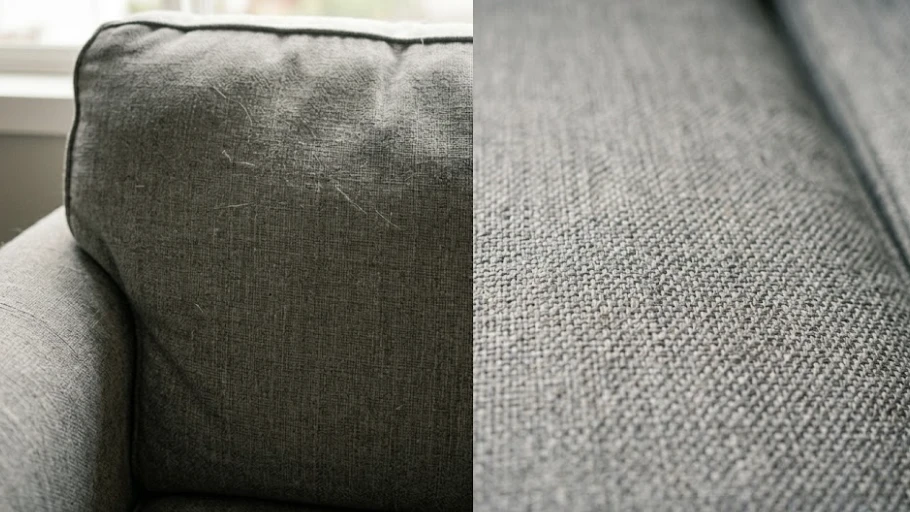
Soil embedded in upholstery fabric is physically abrasive. Fine grit and particulate trapped in the weave act like sandpaper against the fibers every time someone sits down, shifts position, or the cushion is handled. This is one of the primary causes of fabric pilling, thinning, and the general worn look that settles into heavily used couches after a few years. Removing that embedded soil every 12 to 24 months extends the period before you’re looking at a $1,800 to $3,500 replacement purchase.
There’s a practical consideration for renters as well. A sofa returned to a furnished rental apartment in genuinely clean condition is a different thing from one that looks clean but carries 18 months of absorbed odor. Property managers in Lynnwood and the broader Snohomish County rental market encounter both regularly and know the difference. The deposit math is what it is.
None of this is about treating the couch as precious. It’s about the piece of furniture your family actually uses every day — for the movie nights, the sports weekends, the Sunday afternoons where everyone ends up in the same room without particularly planning to. That couch works hard for you. Getting it properly cleaned once in a while is just reasonable maintenance for something you spent real money on and use every single day.