

Proxy servers play a critical role in modern digital infrastructure. A proxy acts as an intermediary between a user and a target website, masking the real IP address and routing traffic through another server. This mechanism helps manage access, protect identity, distribute load, test geo-specific content, and automate large-scale data operations.
For SEO specialists, digital marketers, data analysts, cybersecurity teams, QA engineers, affiliate marketers, and e-commerce businesses, proxies are often part of the operational core. They support search engine data collection, competitor analysis, multi-account management, ad verification, localization testing, price monitoring, and traffic routing across regions.
The central question remains practical and direct: how and where to get proxies that are reliable, relevant, and suitable for specific tasks?
This article provides a structured overview of all available methods to obtain both free and paid proxies using the PROXYAN ecosystem. It explains how the free proxy tool works, how the provider catalog helps select premium solutions, and how different formats fit different business goals.
Get Free Proxies Today: Practical Ways to Access Public IPs
Free proxies remain attractive due to zero entry cost and immediate availability. For short-term experiments, testing environments, non-critical automation, and educational purposes, they often provide sufficient functionality.
PROXYAN offers a dedicated free proxies tool that aggregates, verifies, and updates public proxy servers from multiple global sources. The system automatically checks availability, response time, and anonymity level every 30 minutes. Only responsive IP addresses appear in the table.
The tool supports:
- HTTP
- HTTPS
- SOCKS4
- SOCKS5
Each proxy entry includes:
- IP address
- Port
- Supported protocols
- Anonymity level (Transparent, Anonymous, Elite)
- Country and city
- ISP provider
- Latency
- Uptime percentage
- Last check timestamp
Users can export filtered results in TXT, CSV, or JSON format for integration with software, scrapers, automation tools, or browsers.
Below are two structured ways to obtain free proxies via the platform.
Method 1: Use the Smart Filtering System
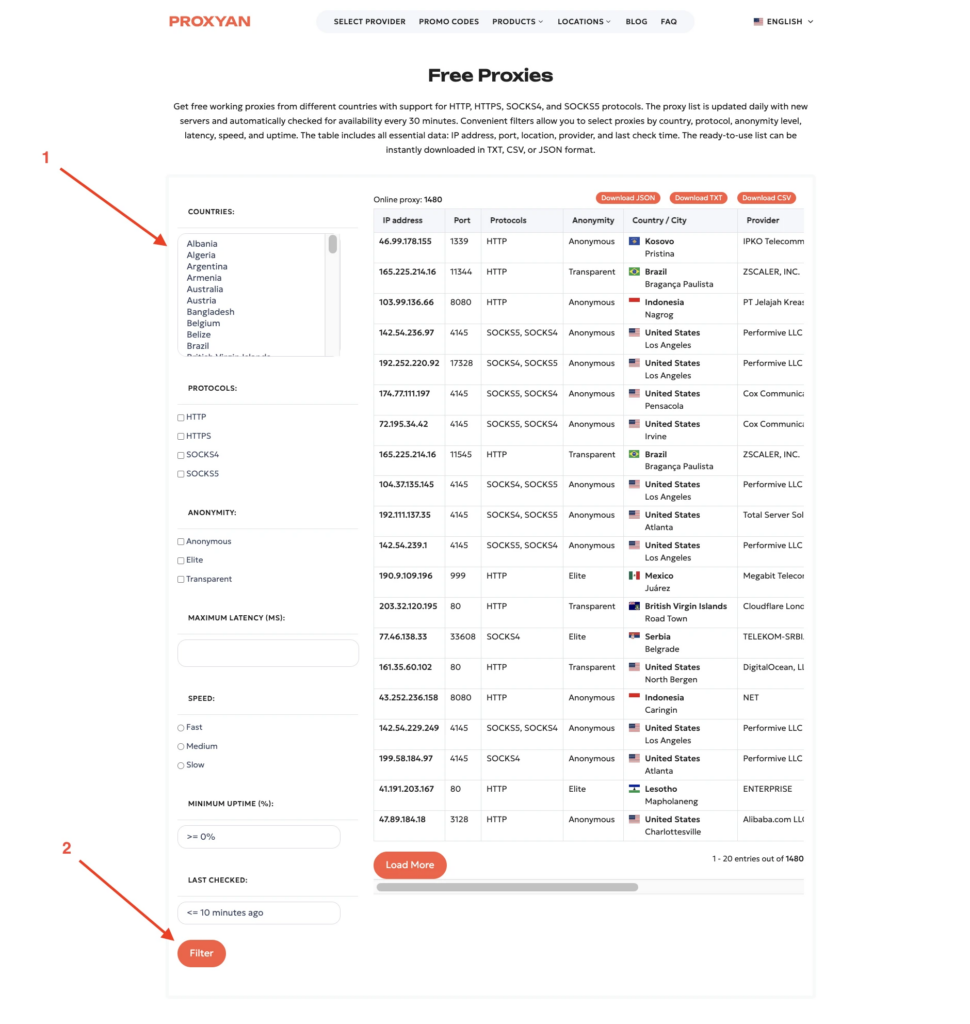
A user navigates to the free proxies page and accesses the live proxy table. From there, several filters allow targeted selection:
- Country selection for geo-specific needs
- Protocol filtering (HTTP, HTTPS, SOCKS4, SOCKS5)
- Anonymity type (Transparent, Anonymous, Elite)
- Maximum latency in milliseconds
- Speed category (Fast, Medium, Slow)
- Minimum uptime percentage
- Last verification time
For example, an SEO specialist scraping localized SERPs may filter by:
- Country: United States
- Protocol: HTTPS
- Anonymity: Elite
- Uptime: ≥ 90%
- Last checked: ≤ 30 minutes
After filtering, proxies can either be copied individually or downloaded in bulk using the export buttons in the upper-right corner.
This method suits professionals who require controlled selection parameters before deployment.
Method 2: Choose Proxies by Country Pages
The second method relies on geographic browsing.
Below the main tool, a structured list of countries displays all available regions with free proxies. After selecting a specific country, users land on a dedicated country page containing only proxies from that location.
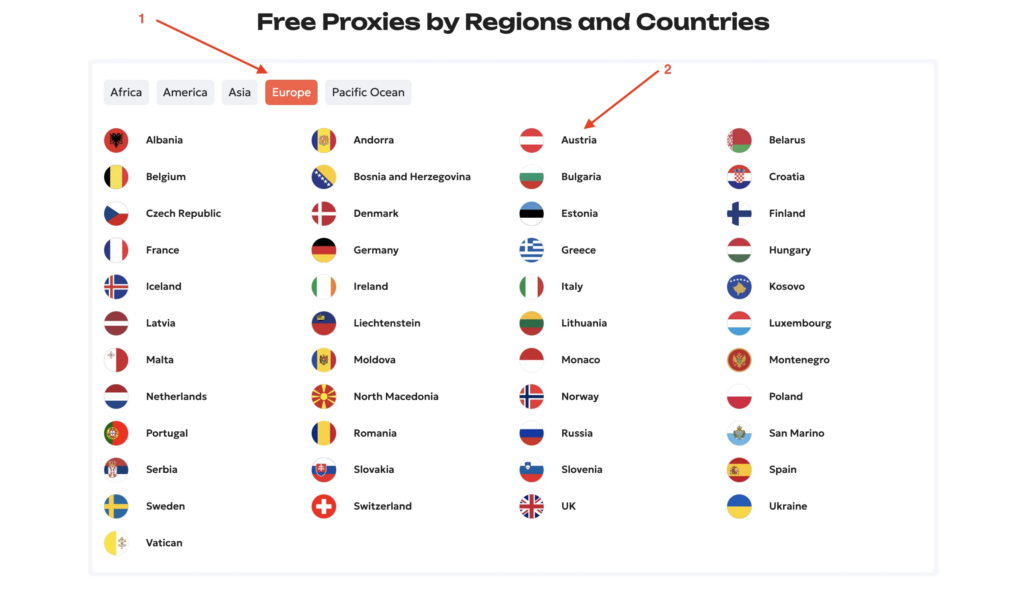
This approach benefits users who prioritize geography over technical filtering. Journalists verifying local content, marketers analyzing regional ads, or developers testing geo-restricted interfaces often prefer this method for its simplicity and clarity.
Both methods offer immediate access without registration barriers, reducing friction and accelerating deployment.
Strengths and Limitations of Free Proxies
Free proxies lower the psychological barrier to entry. Behavioral economics research shows that “zero cost” significantly increases experimentation willingness. However, trade-offs remain.
Advantages of Free Proxies
- No financial investment required
- Immediate access without long onboarding
- Support for multiple protocols (HTTP, HTTPS, SOCKS4, SOCKS5)
- Regular automatic verification every 30 minutes
- Global country coverage
- Filtering by anonymity level
- Filtering by uptime and latency
- Export in developer-friendly formats
- Suitable for short-term tasks and testing
- Helpful for educational and research projects
These advantages make free proxies attractive for non-critical operations and initial experiments.
Limitations of Free Proxies
Despite automation and filtering, public proxies have structural weaknesses:
- Shared usage among multiple unknown users
- Limited stability
- No authentication support (no login/password)
- Potential security concerns
- No guaranteed uptime
- No dedicated technical support
- Risk of blacklisting
- Inconsistent speed under load
For mission-critical business workflows, these limitations often create operational risk.
Unlock Premium Proxy Infrastructure via the PROXYAN Catalog
When reliability, scale, and security become priorities, paid proxies provide a structured solution.
The PROXYAN provider catalog aggregates verified proxy services offering various IP products and infrastructure models. Instead of manually researching dozens of vendors, users compare providers within one organized directory.
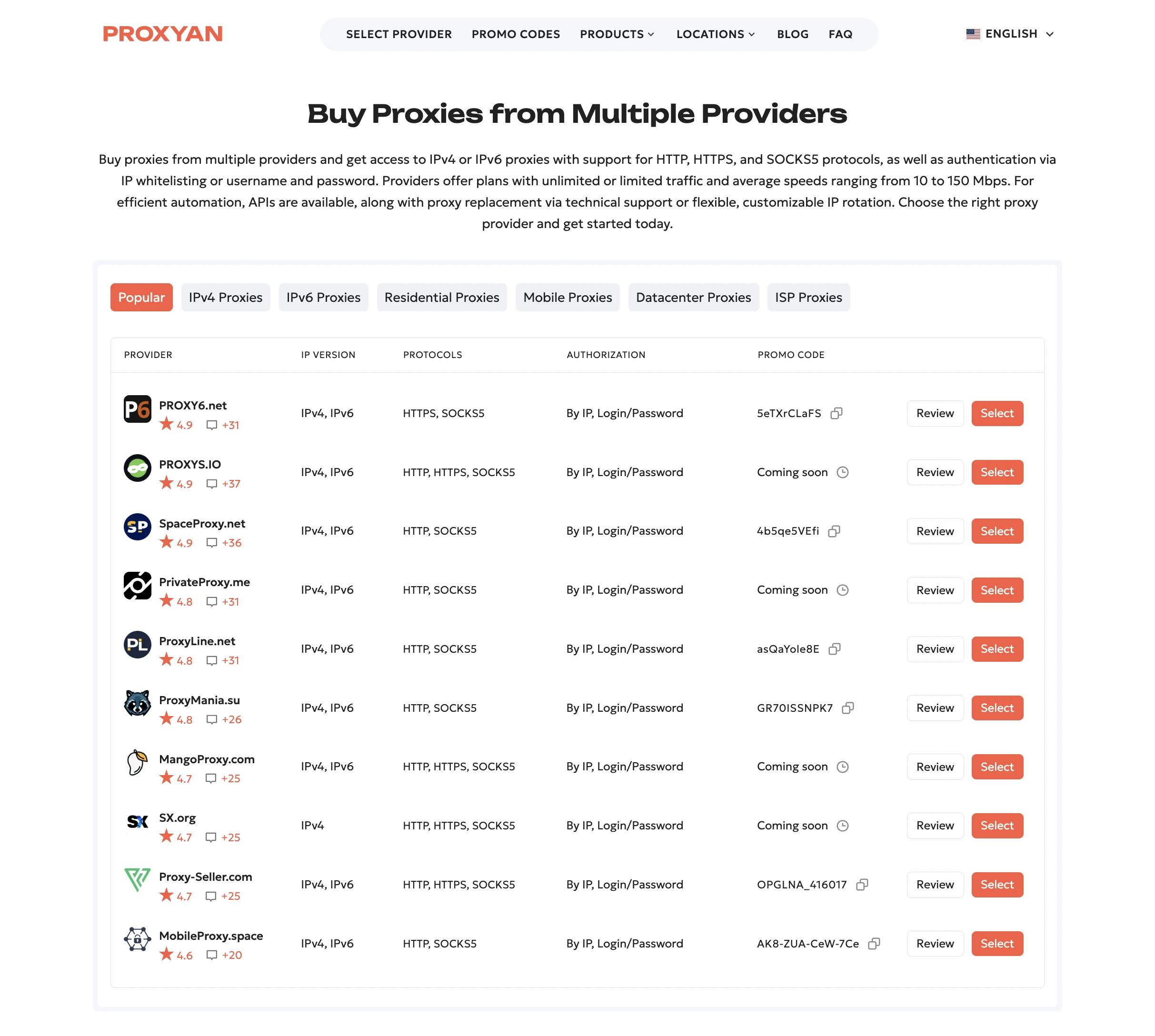
Available proxy types across providers include:
- IPv4 proxies
- IPv6 proxies
- Residential proxies
- Mobile proxies
- Datacenter proxies
- ISP proxies
Supported protocols commonly include HTTP, HTTPS, and SOCKS5.
Authentication methods:
- IP whitelist authorization
- Login and password authentication
Traffic models vary:
- Unlimited bandwidth
- Metered traffic plans
- Request-based billing (in some cases)
Average speed ranges from 10 Mbps to 150 Mbps depending on provider and product.
Some providers offer:
- Free trial periods
- API access
- Flexible rotation settings
- Manual or automatic IP rotation
- Targeted IP replacement via support
How to Get Paid Proxies via the Catalog
The process remains straightforward.
- Visit the PROXYAN homepage.
- Select the required proxy type (for example: Residential or IPv4).
- Click “Choose” next to the selected provider.
- Register on the provider’s website.
- Select a tariff plan and complete the purchase.
This structured pathway reduces research time and decision fatigue. Instead of comparing dozens of unclear offers, users access curated options aligned with technical parameters.
Advantages and Trade-Offs of Paid Proxies
Paid proxies operate under contractual infrastructure models, which significantly changes their reliability profile.
Advantages of Paid Proxies
- Dedicated or controlled IP allocation
- Stable uptime
- Authentication via login/password or IP whitelist
- Flexible rotation settings
- High bandwidth capacity
- API integration support
- Technical support assistance
- Structured pricing plans
- Geo-targeting down to city level (often available)
- Large-scale purchase options
- Lower risk of blacklisting
- Customizable traffic models
These benefits make paid proxies suitable for automation, scraping, ad verification, fintech operations, QA testing, and high-volume data workflows.
Limitations of Paid Proxies
No solution remains perfect.
- Financial cost
- Need for vendor evaluation
- Potential overpayment if traffic estimates are inaccurate
- Contractual terms varying by provider
However, for businesses where downtime or IP bans translate into revenue loss, the cost-benefit ratio often favors premium infrastructure.
Who Needs Proxies and for What Legal Use Cases
Proxies support numerous legitimate and compliance-driven operations across industries.
Common professional use cases include:
- SEO specialists collecting SERP data and analyzing rankings
- Digital marketers verifying ads across regions
- Data analysts gathering public web data
- QA engineers testing geo-specific interfaces
- E-commerce teams monitoring competitor pricing
- Cybersecurity teams conducting threat intelligence research
- Localization agencies verifying content display in different countries
- Affiliate marketers managing campaign accounts
Each of these tasks requires IP diversification, geo-specific access, or anonymity management. Selecting between free and paid proxies depends on scale, sensitivity, and reliability requirements.
Test Free Proxies or Scale with Premium Providers
Free proxies provide accessibility, flexibility, and zero-cost experimentation. They fit short-term testing, educational research, and lightweight automation.
However, public IPs carry structural risks. For stable scraping pipelines, multi-account systems, financial platforms, or corporate analytics environments, professional-grade proxies offer measurable advantages.
The PROXYAN ecosystem combines both entry-level and enterprise-ready pathways. Users can begin with free proxies to test workflows, then transition to verified providers inside the catalog when stability and scale become priorities.
Exploring both options enables informed decision-making based on real operational needs rather than assumptions.