


Bitcoin’s value has suffered during the current global conflict, as risk assets have been hit hard. If a resolution is found, there are several outcomes for its price.
The importance of oil and its correlation to Bitcoin may not seem immediately apparent, but it is strong. When the price of oil goes up, so does everything else, particularly energy. This results in the postponement of rate cuts by central banks, which damages liquidity in the short term. This makes investors turn away from risk assets. Yet if a resolution can be found, and oil starts moving once again, there are several scenarios for Bitcoin.
The Current State of Play for Bitcoin
The current Bitcoin price INR stands at $6,172,967 as of April 2nd, 2026, reduced from a high of 6,434,600 the day before. This volatility stems from a continued change in the possible outcomes and resolution of the conflict in Iran. Bitcoin had jumped 0.2% on possible discussions of important updates, with the S&P futures jumping upward along with Asian stocks having their best day in a month. Yet this was short-lived, as a statement was given that the war would continue for the foreseeable future.
Bitcoins Tie to Oil Prices
To put it in perspective, only 21 tankers have made it through the Strait of Hormuz since the outbreak of the war. Before, this was around 100 tankers per day. In response to a lack of traffic through the Strait of Hormuz, the International Energy Agency, made up of 32 nations, has announced a coordinated release of around 426 million barrels of oil, the largest in its 50-year history. This is to offset a global shortage of around 4.5 to 5 million barrels a day.
Binance highlighted how there is very little that countries can do to resolve this. They noted that these headlines overpromise, as logistics underdeliver. Even a 180 to 400 million barrel coordinated release is throughput-limited, will take months to materialize, and doesn’t solve the core issue if Hormuz transit remains impaired and insurance stays elevated.
Thus, even if a resolution arrives, the knock-on impact will still be huge and long-term. Prices may even be transformed forever, and this could produce further risk-off aversions.
Price Changes on a Positive Outcome
If a resolution is found, then it is definite that short-term traders will pivot back to risk assets. While volatility has been endemic across the board since the breakout of the war, both Bitcoin and Ethereum have remained nowhere near their six-month highs. When tensions are high, their price dips. When they are calm, they begin to rise.
Any de-escalations would mean that lower oil prices would follow, reducing inflation pressure. With an easier monetary policy, Bitcoin would get the support it needs to thrive. Once again, this would not be immediate. Binance noted how stagflation risk is the near-term macro catalyst. This is because CPI and PCE matter because oil’s pass-through hasn’t fully hit the prints yet. An upside surprise delay cuts and reinforces a supply-shock pricing regime, with second-round food inflation risk building via fertilizer and input disruptions.
Bitcoin is failing to make ground in this climate, losing momentum before the $70,000 marker. It has continually tested key levels and been rejected, but is holding firm around the $63,000 marker. This is a tight range that shows no signs of breaking.
It has outpaced stocks, though. While many may try to tag it as a safe haven asset as a result, it is still filled with risk characteristics. The difference is that, regardless of other factors, Bitcoin will still have money coming into it from institutional and corporate investors. Geopolitical tensions do not change their approach; in fact, it often strengthens it, as they buy when the price is low.
Bitcoin’s Price: Should a Resolution Be Found
Should the oil flow increase, prices should drop across the board. Things become cheaper to produce, and energy prices stabilise or may even be lower. The expectation for inflation begins to decline, and central banks consider relaxing their approach and policies. This brings an appetite back for risk assets, of which Bitcoin is one.
Theoretically. Despite the ongoing conflict, there were several issues impacting Bitcoin before this war. Bitcoin has been spiralling since October, long before Iran was on the table. For a real bull run to be forthcoming, these issues should not be overlooked. They have not gone away.
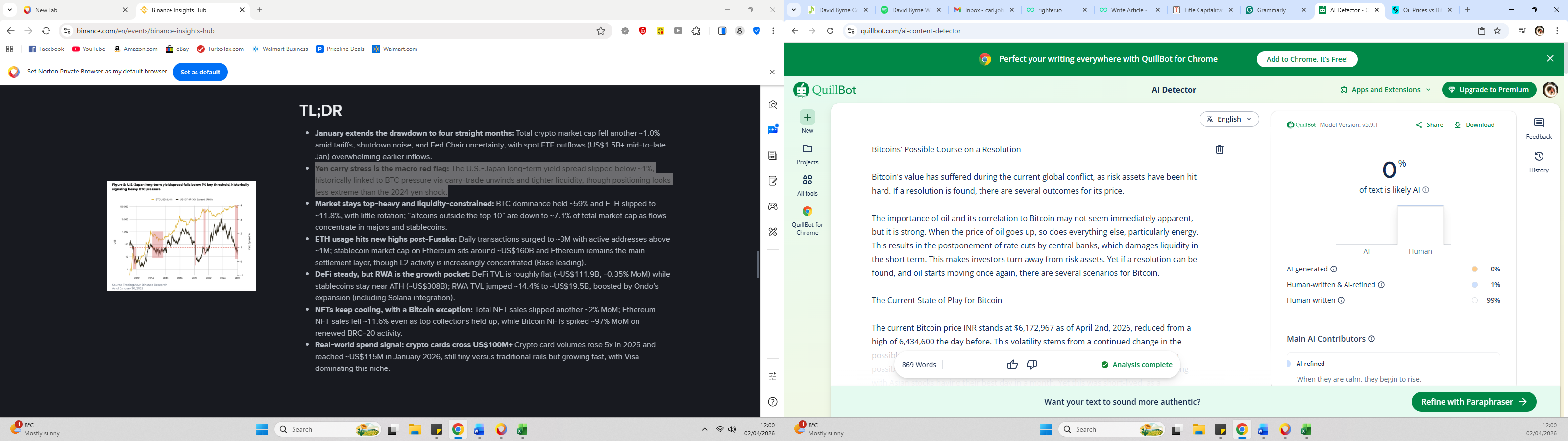
Even in January, Binance noted how the drawdown had extended to four straight months. At the start of the year, the total crypto market cap fell another 1.0% amid tariffs, shutdown noise, and Fed Chair uncertainty. In this climate, they added how spot ETF outflows totalling US $1.5 billion had overwhelmed earlier inflows. Added to this were economic issues outside the US, hitting Bitcoin price and risk assets. They highlighted them as Yen carries stress, being the main macro red flag.
Thus, for an immediate resolution to Bitcoin’s stagnant price, oil is key. With estimates put on a three-week window, though no guarantee, this seems tenuous. Yet even with this, further issues still exist for Bitcoin, and a general change in a cooling global economy may need to be addressed.
- Requirements
- Analytics
- Share