

Customer expectations have evolved drastically over the last decade. Traditional IVR systems—the ones that make callers navigate endless “press 1 for sales, press 2 for support” menus—have become more frustrating than helpful. Customers today demand speed, personalization, and seamless service, and old-school IVRs cannot meet these expectations.
This is where Conversational AI IVR comes in, powered by an AI IVR system and supported by AI call center agent software. Together, they transform the customer experience: the AI IVR system handles routine inquiries automatically, while the AI call center agent software ensures that more complex interactions are managed efficiently, with full context passed seamlessly to human agents when needed.
For businesses, this technology delivers a dual benefit: cost savings without sacrificing customer satisfaction. Companies no longer need to choose between reducing operational expenses and keeping customers happy—Conversational AI IVR with AI IVR systems and AI call center agent software provides both, making it an essential solution for modern call centers
How Conversational AI IVR Significantly Cuts Operational Costs
Operational efficiency is a major concern for any business running a contact center. Conversational AI IVR reduces costs in several meaningful ways, from automating routine inquiries to handling call volume spikes without extra staff.
- Deflecting Routine Inquiries Without Human Intervention: Many customer inquiries are repetitive and time-consuming, such as:
“Where is my order?”
“How can I reset my password?”
“What are your business hours?”
A Conversational AI IVR can automatically handle these tasks. This not only frees up human agents for complex calls but also ensures customers get answers faster, reducing frustration and call abandonment rates. Companies can significantly reduce operational costs by minimizing the workload on live agents while maintaining consistent service quality.
- Lowering Average Handle Time (AHT): Traditional IVRs often force agents to repeat questions or transfer calls multiple times, increasing the average handle time (AHT). Conversational AI IVR collects the caller’s intent upfront, providing solutions directly or routing the call to the right agent with all context attached. This eliminates unnecessary transfers and saves both time and money.
For example, a customer calling about a delayed shipment can immediately be routed to the logistics team with full purchase and tracking information. This streamlined approach reduces AHT and increases first-call resolution.
- Scaling Operations Without Additional Headcount: Call centers often face spikes in call volume during holidays, product launches, or service outages. Traditional systems require hiring temporary staff, which increases operational costs. In contrast, Conversational AI IVR scales effortlessly to handle thousands of simultaneous calls without additional personnel. Businesses can meet seasonal demand without sacrificing service quality or increasing expenses.
- Reducing Zero-Out Rates and Abandoned Calls: Legacy IVRs frequently frustrate callers, leading to “zero-out” rates where customers hang up before their issue is resolved. Conversational AI IVR is designed to solve customer problems within the automated system itself. By keeping more callers engaged and providing effective self-service, companies improve service levels and reduce costly repeat calls.
Conversational AI IVR Boosts Customer Satisfaction (CSAT)
Operational savings are important, but the real power of Conversational AI IVR lies in enhancing the customer experience. A system that’s intuitive, fast, and personalized drives higher customer satisfaction and loyalty.
- Speak Naturally with Advanced NLP: Customers no longer need to memorize confusing menu options. Conversational AI IVR uses natural language processing (NLP) to understand human speech, enabling customers to speak naturally. For example, a customer can say: “I need to check the status of my refund,” instead of navigating multiple menu layers. This reduces frustration and creates a smoother experience.
- 24/7 Instant Support: Unlike human agents bound by business hours, AI-powered IVR provides around-the-clock support. Whether a customer calls at 3:00 AM or during peak hours, the system delivers instant responses without long wait times. This ensures that businesses never miss an opportunity to help a customer, improving overall satisfaction.
- Personalization at Scale: By integrating with CRM systems, Conversational AI IVR recognizes returning callers and anticipates their needs. For instance:
“Hi Sarah, I see you recently placed an order for a laptop. Do you want to track your shipment?”
Such personalization not only makes customers feel valued but also reduces call duration because the AI can suggest relevant solutions immediately.
- Smooth Human Escalation: There are times when a live agent is needed. Conversational AI IVR ensures a frictionless handoff by passing all customer context to the agent. This eliminates the need for customers to repeat themselves, increases first-call resolution, and ensures agents can focus on solving complex problems rather than gathering basic information.
Top Conversational AI IVR Solution Providers
Choosing the right Conversational AI IVR platform is essential for maximizing both cost savings and customer satisfaction. Different providers offer unique capabilities, but some stand out for their innovation and scalability.
- Bright Pattern: Known for its omnichannel-first Conversational AI IVR, Bright Pattern excels at seamlessly transitioning between voice AI and live agents while maintaining full customer context across channels. Its robust AI IVR system and integration with AI call center agent software make it an ideal choice for businesses that want consistent, personalized experiences across multiple touchpoints. Bright Pattern also provides intuitive tools for administrators, allowing quick updates to dialogue flows without extensive technical expertise.
- Five9: Offers Intelligent Virtual Agents (IVAs) that use advanced natural language processing to automate complex phone interactions. This reduces the need for human intervention on routine tasks, improving efficiency while still providing a natural customer experience.
- Genesys Cloud CX: Focuses on empathy-driven AI IVR, enabling real-time personalization based on customer data. Its AI IVR system adapts to caller intent, helping to improve satisfaction, loyalty, and first-call resolution.
- Talkdesk: Features AI Trainer tools that allow businesses to refine IVR speech recognition and dialogue flows without requiring a dedicated data science team. This makes it easier for organizations to continuously optimize their Conversational AI IVR performance.
- Nice CXone: Combines conversational bots with deep analytics, helping businesses identify bottlenecks and optimize operations for maximum efficiency and cost savings.
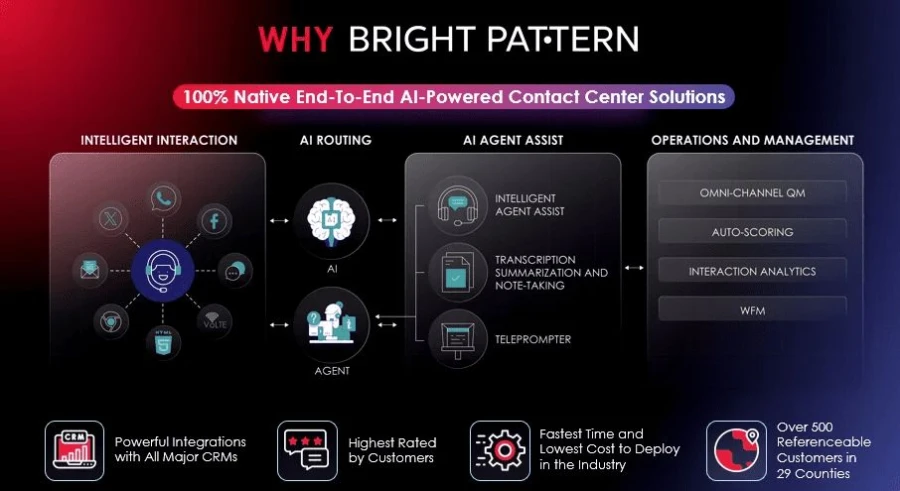
While all these platforms demonstrate the transformative potential of Conversational AI IVR for modern customer service, Bright Pattern stands out for its seamless omnichannel integration, ease of management, and strong support for AI-powered call center agent workflows, making it a top choice for businesses looking to modernize their contact centers.
Key Features of a High-ROI Conversational AI IVR
For a Conversational AI IVR to deliver real value, certain features are essential:
- Multi-Language Support: Global businesses need to serve customers in multiple languages. Multi-language AI ensures consistent service quality worldwide without the expense of local call centers.
- Omnichannel Continuity: Customers may start a conversation over the phone, continue it via chat, and finish through email. Conversational AI IVR bridges these channels, ensuring omnichannel consistency so conversations are seamless, no matter the touchpoint.
- Real-Time Analytics: Modern AI IVRs provide real-time insights, tracking where customers drop off or experience frustration. This data helps businesses continuously refine dialogue flows, improve automation accuracy, and identify new opportunities for cost savings.
- Self-Learning and AI Training; Advanced systems learn from interactions, adapting over time to improve recognition accuracy and response quality. This ensures that your Conversational AI IVR continues to improve without constant manual intervention.
Implementing Conversational AI IVR: A Practical Strategy
Transitioning from legacy IVR systems to a modern Conversational AI IVR requires careful planning and a clear strategy. Here’s a practical approach to ensure a smooth and effective rollout:
- Start with Quick Wins: Begin by identifying the top three high-volume, low-complexity inquiries that can be automated. Typical examples include password resets, order tracking, and frequently asked questions. Automating these routine tasks not only demonstrates a quick ROI but also allows your team to get comfortable with the new system, building momentum and confidence for broader adoption.
- Adopt a Hybrid Approach: Striking the right balance between automation and human support is key. Let the AI IVR handle repetitive, predictable tasks, while live agents focus on complex or sensitive interactions that require empathy and judgment. This hybrid model ensures operational efficiency without compromising the quality of the customer experience.
- Measure Success Beyond Costs: While reducing operational costs is important, it’s equally critical to track the impact on customer experience. Use metrics such as Net Promoter Score (NPS), sentiment analysis, and first-call resolution to evaluate how well your Conversational AI IVR is meeting customer expectations. These insights help justify the investment and guide further improvements.
- Continuous Improvement: A successful Conversational AI IVR is never “set and forget.” Leverage real-time analytics and feedback loops to continuously refine your system. Monitor failed interactions, update dialogue flows, and enhance AI understanding over time. This iterative approach ensures the AI evolves alongside customer needs, keeping your contact center efficient, relevant, and customer-focused.
Conclusion: Why Conversational AI IVR Is a Must-Have
Conversational AI IVR is no longer optional—it’s a strategic necessity for businesses looking to stay competitive. By reducing operational costs, improving first-call resolution, and providing personalized, 24/7 service, AI IVR systems deliver measurable ROI while delighting customers.
Investing in Conversational AI IVR today builds long-term customer loyalty, enhances operational efficiency, and future-proofs your contact center. Companies that adopt AI IVR and intelligent call center solutions now are positioning themselves as leaders in customer experience for 2026 and beyond.
In a world where customer expectations are higher than ever, Conversational AI IVR is the bridge between efficiency, personalization, and brand loyalty—a must-have technology for modern businesses.