

The Mazda 3 BM/BN from model years 2013 to 2019 is a car that still does a lot of things right. The design still looks modern today, the handling feels direct, and in everyday use the car is pleasantly reliable. When it comes to sound, however, there is one difference that many owners only fully understand later: not every Mazda 3 came from the factory with the same audio foundation. And that is exactly what matters if you want more punch, more volume, and above all significantly better sound in the car.
In this generation of the Mazda 3 there were two fundamentally different factory setups. On the one hand there was the normal standard system, and on the other hand the Bose system. From the outside many people think they are similar, but technically the difference is substantial. And that is exactly why not every car is equally easy to upgrade.
The important difference between Standard and Bose
If you drive a Mazda 3 BM/BN with the normal sound system, you actually have the much better basis for an aftermarket upgrade. That may sound surprising at first because Bose appears to be the more premium option on paper. In practice, however, the standard system is often far more forgiving when you want to install a really powerful aftermarket system.
The Bose system in the Mazda 3 BM/BN is a factory-tuned 9-speaker system with its own DSP-controlled amplifier and a special impedance. That is exactly where the problem begins. These speakers do not work like classic 4-ohm aftermarket speakers that you can simply swap in one for one. If you try to replace the factory radio or the speakers in the Bose system without considering the underlying setup, you quickly run into problems. If the factory radio is replaced with an aftermarket head unit, you need a Bose active system adapter so that the original system can still output sound at all. Without that adaptation, the result may simply be silence.
The situation is completely different with the normal standard system. There is no complex factory amplifier and DSP structure behind it, just a simple base audio setup with eight speakers. In the doors there are 165 mm speakers front and rear, plus tweeters in the dashboard. The factory radio drives everything directly and only delivers a limited output of roughly 15 to 20 watts per channel. And that is exactly the point where a proper upgrade can make an enormous difference.
Why the Standard system is the better basis for serious sound
Many drivers want to keep the original Mazda radio because the dashboard remains visually clean and all factory vehicle functions stay in place. That is not a problem in the Mazda 3 BM/BN. So you do not necessarily have to replace the radio to get dramatically more sound quality and output in the car. That alone is what makes this upgrade so attractive.
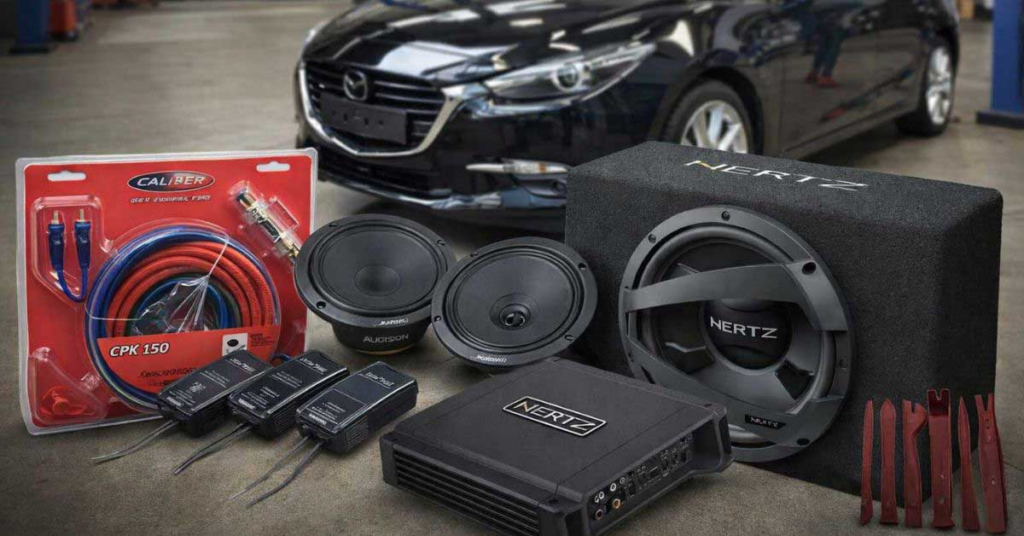
If you have a Mazda 3 with the standard sound system, you can still connect a powerful aftermarket setup with up to 2000 watts maximum power. The trick is that the signal does not need to come from classic RCA outputs. Instead, it works through high-level inputs. The Hertz HCP 4DK is especially suitable for that because it can be driven either by RCA or by high level.
The big advantage is that you do not have to cut any original wires. Instead of a rough custom wiring job, a T-adapter is inserted between the radio and the vehicle plug. From there, additional signal outputs are connected to an extension cable that runs to the amplifier. This leaves the original wiring untouched, and the factory radio can still switch the amplifier on and off correctly. That exact setup is what makes the whole system practical for daily use and technically elegant.
What is actually installed in this upgrade
At the front, Audison APK165P speakers are used, meaning powerful 165 mm component speakers that can do far more than the factory Mazda speakers. These systems do not just play louder, they also play with more control, more dynamics, and far more clarity. Voices sound cleaner, instruments are more precisely placed in the soundstage, and the midbass has very little in common with the factory setup. Anyone who wants to see in advance what is possible in this vehicle can get a good introduction from Mazda 3 Typ BM/BN Lautsprecher in den Türen tauschen.
At the rear, Audison APX 6.5 coaxial speakers are installed. These complement the front system in a sensible way without tearing apart the sound image. In daily use, that creates a fuller sense of space without losing the front stage. The key element, however, is the amplifier, because only with proper amplification do the speakers receive the power that the factory radio could never provide.
And because the Hertz HCP 4DK offers multiple channels, it is also possible to run an additional 30 cm subwoofer in an enclosure. The Hertz DBX 30.3 is a solution that not only looks strong on paper but also produces real deep bass in the car. This is exactly the point where many drivers experience for the first time how big the difference is between “more volume” and a real sound upgrade. The bass does not just get louder, it gets deeper, fuller, and more physical. The whole car suddenly reacts to music in a completely different way.
Why door damping is not just an extra here
An upgrade like this does not work through speakers and amplifier alone. If the doors remain acoustically weak, you are throwing away potential. That is why power cables and materials for door damping are a sensible part of such a package. The damping significantly improves the working conditions of the speakers. The door becomes more stable, resonances are reduced, and the bass from the door speakers becomes stronger and cleaner.
At the same time, the subwoofer in the vehicle benefits as well. When the car as a whole becomes acoustically quieter and more controlled, the perceived bass pressure rises. The result is not only more deep bass, but an overall more mature sound.
More power than Bose – and often even cheaper
This is exactly where the whole concept becomes especially interesting. Many people initially think the Bose system must be the better solution because it sounds “premium” from the factory. But once you hear a properly built aftermarket system in a standard Mazda 3, that impression often changes very quickly. The upgrade described here offers much more reserve, much more dynamics, and much more deep bass than the original Bose system – and still stays below 1000 US dollars.
For what it offers in real power, sound improvement, and upgrade potential, it is a very strong value proposition. Anyone who wants to learn more about matching components and complete packages can get a direct overview from Mazda 3 BM/BN Soundsystem Upgrade 2000 Watt Max.
Conclusion
The Mazda 3 BM/BN with the standard sound system is a surprisingly good foundation for a serious sound upgrade. While the Bose system is technically much more complicated and cannot simply be replaced one for one with aftermarket components, the standard system can be upgraded very cleanly and very effectively. With high-level integration, a T-adapter, a powerful amplifier, new Audison speakers, a 30 cm subwoofer, and door damping, you end up with a system that leaves the factory sound far behind.
So if you want to hear music in your Mazda 3 with real punch, clear vocals, and true deep bass, you do not necessarily have to sacrifice the factory radio. That is exactly what makes this upgrade so attractive. You can find more technical background, vehicle-specific solutions, and installation topics at Auto-Lautsprecher – Technik und Einbau verstehen.